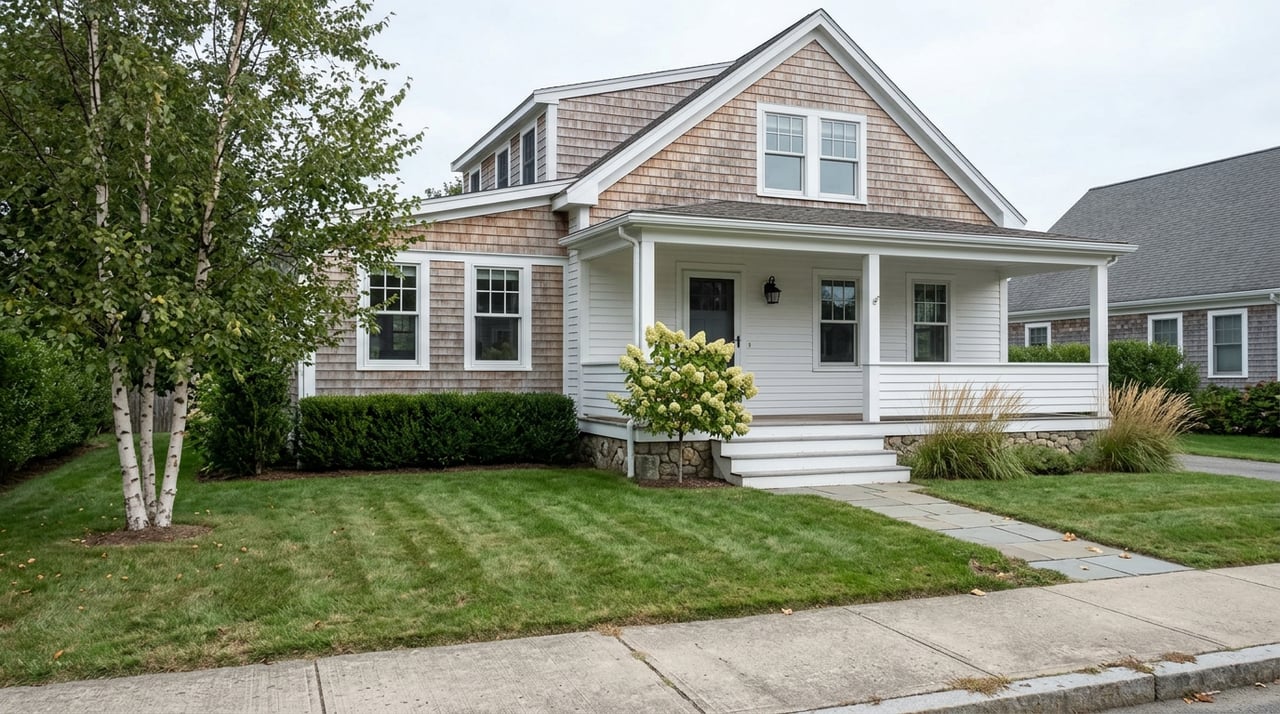
Boyne City Short-Term Rental Cap: What to Check Before Buying
September 17, 2026
A listing agent walks you through a three-bedroom bungalow six blocks from Lake Charlevoix and notes that similar homes nearby pull strong nightly rates in summer. The pitch sounds reasonable. Boyne City has the lake, the downtown, the ski hill fifteen minutes south. Why wouldn't this house work as a short-term rental?
Here is a key question to ask: does this particular address still have room under the cap?
Boyne City does not leave short-term rental capacity open-ended. The city caps the number of licensed short-term rentals allowed in its Traditional Residential District, and that district holds more than half the city's housing stock. If you are buying with rental income in mind, the nightly rate someone else is earning down the street tells you what the market will pay. It does not tell you whether the city will let you collect it.
Boyne City's rental market moved fast in 2022. Short-term rentals in the city climbed by roughly 39 percent over that spring and summer, according to STR Profit Map; that pace pushed the City Commission to act. Commissioners spent months working through the tradeoffs before approving a dedicated short-term rental ordinance on December 13, 2022, following extensive public input on the impacts to year-round housing.
The commission passed that ordinance without settling on a hard number. They could not agree on a cap that first night, so they moved ahead with the licensing structure and left the ceiling for later. Eleven months after that, in November 2023, the city closed that gap. It set a cap of 130 short-term rental units in the Traditional Residential District, as Petoskey News reported. That district itself contains 54 percent of the city's total housing units.
Run the math on that and the shape of the constraint gets clearer. A cap of 130 units against a district holding 54 percent of Boyne City's housing works out to roughly one licensed rental for every ten homes in that zone. That is not a soft guideline. It is a fixed number of slots.
| Figure | What it represents |
|---|---|
| 39% | Increase in short-term rentals across Boyne City, spring to summer 2022, the surge that prompted the ordinance |
| Dec. 13, 2022 | Date the City Commission approved the short-term rental ordinance |
| 54% | Share of Boyne City's total housing units located in the Traditional Residential District |
| 130 | Cap on licensed short-term rental units in that district, set November 2023 |
| ~10% | Approximate share of homes in the Traditional Residential District that the cap allows to hold a license |
That last line is the number worth sitting with. The cap allows licenses for roughly one in ten homes in Boyne City's largest residential zone at a time.
The ordinance itself, filed under Chapter 15 of the city's code, spells out how licenses actually behave once the cap exists. A license runs on an annual term ending December 31, and an owner has to renew it before that date or the license lapses. Enforcement escalates with each violation: a first offense within a calendar year brings a written warning, a second brings a municipal fine, and a third stops new bookings for the rest of the year. If a license is revoked, the ordinance is specific about what happens next: the property owner goes to the bottom of the short-term rental waiting list, if one exists.
That detail alone tells you the cap is not a formality. A waiting list only matters if there are more people who want in than there are open slots, and the ordinance was written with that scenario in mind from the start.
One carve-out is worth knowing if you are weighing a smaller-scale option. The ordinance excludes what it calls Rental Personal Units, meaning an owner-occupied property with an accessory dwelling unit rented out, from the cap calculation entirely. That is a narrower play than renting out a whole single-family home, but it is a path that does not compete for one of the 130 slots.
None of this shows up in a home's square footage or its Zestimate. It shows up in one place: whether that specific parcel already holds an active short-term rental license, and if not, where the waiting list currently stands.
A home that already carries a license is worth more to a buyer who wants rental income than an identical home two doors down without one. To check a specific parcel's status, ask the city directly. Boyne City's Planning and Zoning department, led by City Planning Director Zachary Sompels, handles these questions and the city's short-term rental page is the starting point for checking a property's status before you write an offer.
This is also where Boyne City diverges from some of its neighbors. Nearby communities in the region have taken different approaches to the same pressure. The mechanism matters because it changes what a buyer is actually purchasing. In Boyne City, the constraint is a numeric ceiling on a specific district. A buyer who assumes the two work the same way is making a guess where the city has already published an answer.
If a Boyne City listing is being marketed with rental income as part of its appeal, three questions are worth settling before an offer goes in, not after.
Does this address currently hold an active short-term rental license, and is that license set to renew before December 31 of this year?
Is the property inside the Traditional Residential District, or in a different zoning classification where the 130-unit cap may not apply the same way? The city's zoning map, available through the Planning and Zoning office, settles this faster than a listing description will.
If there is no existing license, what does the current waiting list look like? A property with strong rental comps and no license, sitting behind a full waiting list, is a very different purchase than the same house with a license already attached.
If you own a short-term rental license in the Traditional Residential District, buyers who understand the cap will ask about it. Buyers who understand the cap will ask about it.
Does the cap apply to properties near Boyne Mountain or outside the city limits? The 130-unit cap is specific to Boyne City's Traditional Residential District. Properties in different zoning classifications, or outside city limits entirely, fall under different rules. Confirm the parcel's zoning before assuming the cap applies.
Are accessory dwelling unit rentals affected by the cap? No. The ordinance excludes what it defines as Rental Personal Units, owner-occupied properties with a rented accessory unit, from the 130-unit count.
Who do I contact to check a specific address? Boyne City's Planning and Zoning department maintains license and zoning records for individual parcels. That office, not a listing sheet, is the reliable source for a property's current status.
Rental income potential is one of the more persuasive lines in a Boyne City listing, and it is often true as far as it goes. Whether it applies to the specific house you are considering is a separate question. Confirm the property's license status with the city before relying on rental income in your plans.
If you are weighing a Boyne City purchase with rental income in the picture, or preparing to sell a property that already carries a license, Genna Hill can walk through what a specific parcel's status actually means for your plans. Let's Connect.
This article is general information, not legal, tax or financial advice. Consult a qualified professional about your situation.
Stay up to date on the latest real estate trends.
Connect with a real estate professional who values trust, insight, and personal attention. Every step is guided by a deep understanding of what “home” truly means.